Table of Contents
ToggleThe tiny home movement has evolved far beyond the minimalist lifestyle experiments and trailer-mounted cabins of a decade ago. Today’s luxury tiny homes on foundations represent a deliberate choice, sophisticated, permanent residences that combine compact footprints with high-end finishes, smart systems, and thoughtful design. These aren’t compromise dwellings. They’re engineered spaces where every square foot serves a purpose, and quality trumps quantity. Whether someone’s downsizing from a traditional home, adding a premium ADU to their property, or building a primary residence that prioritizes location and craftsmanship over sheer size, foundation-based luxury tiny homes deliver a compelling alternative to conventional construction.
Key Takeaways
- Luxury tiny homes on foundations range from 400 to 1,000 square feet and combine premium materials, craftsmanship, and smart design rather than size to create sophisticated permanent residences.
- Foundation-based construction enables conventional financing, heavier luxury features like stone fireplaces and soaking tubs, superior insulation, and appreciation potential comparable to traditional real estate.
- High-end finishes—hardwood cabinetry with soft-close slides, natural stone surfaces, frameless glass showers, and proper trim work—immediately signal quality and justify the luxury price point.
- Smart home technology including mini-split HVAC systems, integrated lighting controls, roof-mounted solar with battery storage, and smart leak detection maximize efficiency in compact spaces.
- Expect $200 to $400+ per square foot for turnkey luxury tiny home builds, with material upgrades, professional fees, and permitting adding significant costs beyond the base construction.
- Zoning and permitting compliance is the biggest obstacle; check local minimum square footage requirements, explore ADU regulations in jurisdictions like Portland and Austin, and consult land-use attorneys for unclear ordinances.
What Makes a Tiny Home on a Foundation Truly Luxurious?
Square footage alone doesn’t define luxury in tiny home construction. A luxury tiny home on a foundation typically ranges from 400 to 1,000 square feet, built with permanent construction methods on a concrete slab, crawlspace, or pier-and-beam foundation. What separates luxury from standard construction comes down to material selection, craftsmanship, and design sophistication.
Premium materials form the baseline: engineered hardwood or natural stone flooring instead of vinyl plank, solid-wood cabinetry with dovetail joinery rather than particle board boxes, and full-thickness countertops in quartz, granite, or butcher block. Trim work matters, baseboards, crown molding, and casing should be real wood, properly mitered and coped, not pre-primed MDF.
Bathroom and kitchen fixtures signal quality immediately. Look for solid brass or stainless steel faucets from manufacturers like Kohler, Delta, or Grohe, not builder-grade chrome-plated plastic. A luxury tiny home often includes a full-size soaking tub or walk-in shower with frameless glass, tiled with natural stone or high-end porcelain, not a fiberglass insert.
Architectural details elevate the space: vaulted ceilings with exposed collar ties, custom built-ins that maximize storage without feeling cramped, and thoughtful window placement that frames views and floods the interior with natural light. These homes feel luxurious because every detail, from the tactile quality of door hardware to the acoustics between rooms, has been considered and executed at a higher standard than typical residential construction.
Benefits of Building a Luxury Tiny Home on a Foundation vs. on Wheels
Choosing a foundation over wheels fundamentally changes what’s possible in design, financing, and long-term value. A permanent foundation classifies the structure as real property, not a vehicle, which opens conventional mortgage and refinance options that trailer-mounted tiny homes can’t access. Lenders treat foundation tiny homes like standard residential construction, provided they meet local building codes.
Structurally, eliminating road-travel constraints removes weight and size restrictions. Builders can use full 2×6 or 2×8 wall studs instead of lighter framing, install ceramic tile without worrying about road vibration cracking grout lines, and design taller ceilings, often 9 to 10 feet instead of the 13’6″ maximum road height. Plumbing and electrical systems don’t need to be winterized or designed for movement: waste lines can use standard pitch and venting without special flex fittings.
Foundations also permit heavier luxury features: cast-iron soaking tubs, full-height stone fireplace surrounds, and multi-zone HVAC systems with ductwork that wouldn’t survive highway speeds. Insulation values improve dramatically, foundations allow for proper vapor barriers, full-depth spray foam or batt insulation in walls and ceilings, and thermal breaks that wheeled units struggle to match due to weight limits.
Permanence affects property value, too. Foundation tiny homes appreciate like traditional real estate in desirable markets, especially when positioned as accessory dwelling units (ADUs) on existing lots. Many jurisdictions now embrace luxury mountain homes and similar high-end compact construction as viable housing solutions, which has improved resale liquidity compared to mobile units.
Design Features That Define Luxury in Foundation-Based Tiny Homes
High-End Materials and Finishes
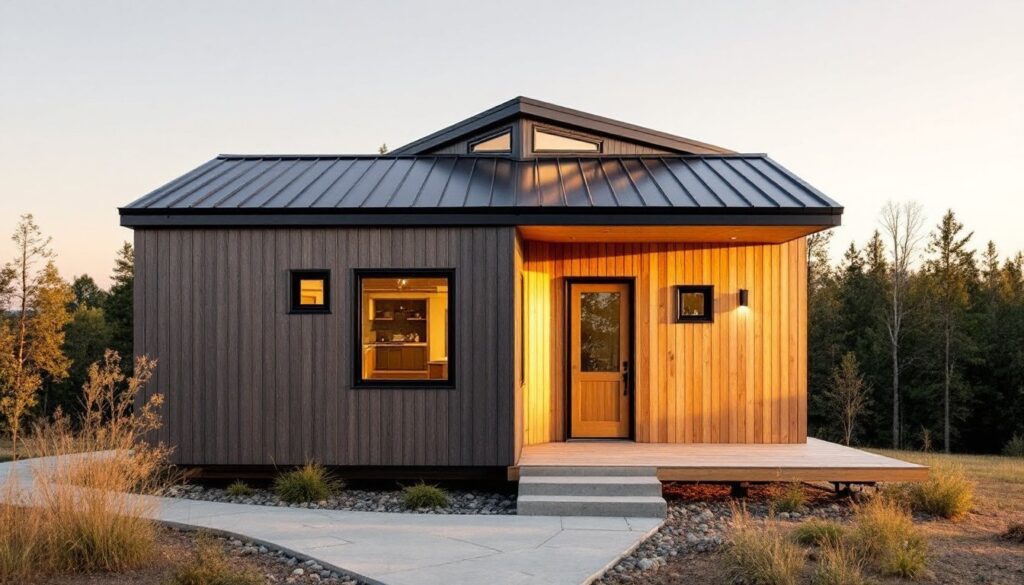
Luxury tiny construction demands precision in material selection, every surface is visible, and cheap finishes stand out immediately. Exterior cladding often combines materials: fiber cement lap siding (like James Hardie) with natural wood accents, metal roofing with concealed fasteners, or vertical board-and-batten with a rainscreen cavity behind it for moisture management.
Interior wall treatments go beyond standard drywall and paint. Many builders incorporate shiplap, tongue-and-groove paneling, or textured plaster as accent walls, but execution matters, poorly installed shiplap with visible fasteners looks cheap, not rustic. Flooring choices should account for the visual impact of fewer transitions: wide-plank engineered hardwood (7″ or wider) in a single species throughout creates continuity, while luxury vinyl plank, even though durability, rarely achieves the same effect.
Cabinet construction reveals quality fast. Dovetailed drawers on full-extension soft-close slides, face-frame construction in hardwood (maple, oak, or cherry), and integrated LED lighting separate custom or semi-custom cabinetry from stock boxes. Countertops in compact kitchens benefit from materials that read as continuous surfaces, quartz slabs with matching backsplashes, or edge-grain butcher block finished with food-safe hardwax oil, not polyurethane that yellows.
Bathroom finishes should mirror full-size luxury construction: frameless glass shower enclosures, porcelain tile installed with thin-set (not mastic, which fails in wet areas), linear drains for curbless entries, and in-floor radiant heat if the budget allows. According to Architectural Digest, high-end tiny homes increasingly feature spa-like bathrooms that rival traditional homes in material quality.
Smart Home Technology and Sustainable Systems
Compact spaces benefit enormously from integrated technology and high-performance building systems. Smart HVAC controls, like Ecobee or Nest thermostats paired with mini-split heat pumps, allow zone-by-zone climate management without ductwork eating into wall cavities. Mini-splits from Mitsubishi, Fujitsu, or LG offer efficiencies (SEER ratings above 20) that window units can’t touch, and wall-mounted heads are far quieter than traditional forced-air systems.
Lighting control systems (Lutron Caseta, Leviton, or hardwired DMX setups) let occupants adjust intensity and color temperature throughout the day, which matters in small spaces where harsh overhead lighting feels oppressive. Recessed LED fixtures should be IC-rated for insulated ceilings and dimmable to at least 10% to avoid that “operating room” effect at night.
Energy independence is a hallmark of luxury tiny construction. Roof-mounted solar arrays sized to offset 80-100% of annual consumption, typically 3 to 5 kW for a well-insulated tiny home, pair with whole-home battery storage (Tesla Powerwall, Enphase, or Generac PWRcell) for grid independence or backup power. Advanced builders use sustainable construction methods that prioritize air sealing and mechanical ventilation over passive leakage, installing HRV or ERV systems that exchange stale air without losing conditioned energy.
Water systems in luxury builds might include on-demand recirculating pumps for instant hot water, whole-house filtration, or even rainwater harvesting tied to irrigation and non-potable uses if local codes permit. Smart leak detection (Flo by Moen, Phyn) provides peace of mind in spaces where a single pipe failure can affect the entire living area.
Cost Considerations: What to Expect When Building a Luxury Tiny Home on a Foundation
Luxury tiny home construction costs vary widely based on location, finishes, and site conditions, but expect $200 to $400+ per square foot for turnkey builds with high-end systems and materials. A 600-square-foot luxury tiny home might run $120,000 to $240,000, not including land acquisition or site prep.
Foundation costs depend on soil conditions and design. A simple 4″ concrete slab with vapor barrier and perimeter insulation runs $4 to $7 per square foot for materials and labor in most markets, while a pier-and-beam foundation with treated wood or steel posts adds $8 to $12 per square foot. Excavation, grading, and utility trenching (water, sewer, electric) can add another $5,000 to $15,000 depending on distance from street connections and local bedrock depth.
Material upgrades separate luxury from standard construction. Switching from builder-grade to premium cabinetry adds $8,000 to $15,000 in a tiny home kitchen. High-performance windows, triple-pane with Low-E coatings and argon fill, cost $600 to $1,200 per unit installed, versus $300 to $500 for standard double-pane. Metal roofing with standing seams runs $10 to $14 per square foot installed compared to $4 to $6 for architectural shingles, but longevity (50+ years vs. 20-30) and energy performance justify the premium in permanent construction.
Smart systems and automation add $5,000 to $20,000 depending on complexity: a basic smart thermostat and lighting package might run $2,000, while whole-home integration with voice control, motorized shades, security cameras, and network infrastructure pushes costs higher. Solar and battery backup systems range from $15,000 to $35,000 after federal tax credits, with payback periods of 8 to 15 years depending on utility rates.
Don’t overlook permitting and professional fees. Architectural or design services for custom tiny homes run $3,000 to $10,000. Permit costs vary wildly, some jurisdictions charge a flat $500 to $2,000, others calculate fees as a percentage of project value. If the build includes septic (because municipal sewer isn’t available), add $10,000 to $25,000 for design, permitting, and installation of a compliant system. Similarly, luxury waterfront properties often face additional permitting hurdles that affect budget and timeline.
Owner-builders can reduce labor costs by 30-40%, but luxury finishes demand skill, improper tile installation, poorly mitered trim, or faulty electrical work kills resale value and creates safety hazards. If experience doesn’t extend to finish carpentry, tile setting, or low-voltage systems, hire licensed trades for those phases.
Zoning, Permits, and Legal Requirements for Foundation Tiny Homes
Navigating zoning and permitting represents the single biggest obstacle for foundation tiny homes. Municipalities regulate minimum dwelling sizes, setbacks, and allowable uses, and many older ordinances don’t anticipate high-quality small homes. Start by confirming the property is zoned for residential use and that no minimum square footage exceeds the planned build size. Some jurisdictions enforce 600, 750, or even 1,000-square-foot minimums for primary residences.
Accessory Dwelling Units (ADUs) offer a clearer path in many areas. Cities like Portland, Seattle, Austin, and various Texas markets have streamlined ADU permitting, allowing smaller secondary structures on lots with existing primary residences. ADU regulations typically specify maximum sizes (often 800 to 1,200 square feet), setback distances from property lines (commonly 5 to 10 feet), and parking requirements (usually one space per unit, though some jurisdictions waive this near transit).
Building permits require construction documents that comply with the International Residential Code (IRC) or applicable local amendments. Plans must show foundation design with frost-depth footings for the climate zone, structural framing that meets span tables for joists and rafters, and electrical/plumbing layouts that satisfy NEC and IPC standards. Expect multiple inspections: footing and foundation, framing and sheathing, rough plumbing and electrical, insulation and vapor barrier, and final. Each must pass before proceeding to the next phase.
Setback and easement rules affect placement. Typical setbacks require 5 to 25 feet from front property lines, 5 to 10 feet from sides, and 10 to 20 feet from rear boundaries. Utility easements, often 10 feet wide along property edges, prohibit permanent structures. Survey the lot and confirm easement locations before finalizing the foundation plan: moving a foundation after the pour is prohibitively expensive.
Septic and well permits apply if municipal services aren’t available. Septic system design depends on soil percolation rates (determined by perc tests) and projected daily wastewater volume. A luxury tiny home with low-flow fixtures might generate 150 to 250 gallons per day, requiring a smaller drainfield than a conventional house, but soil conditions and setbacks from wells or property lines govern final design. Perc tests and septic permits can take weeks to months, so start early.
Some regions now recognize tiny homes in dedicated communities or on agricultural land. States like California, Oregon, and Colorado have adopted statewide ADU laws that preempt restrictive local ordinances, but enforcement varies. Consult a local land-use attorney or experienced builder if zoning appears unclear, variances and conditional use permits are possible but add time and cost. Many luxury resort-style developments have integrated tiny homes as part of mixed-use planning, which may offer precedents in similar jurisdictions.
Finally, covenants, conditions, and restrictions (CC&Rs) in planned communities or HOAs may prohibit tiny homes regardless of zoning. Review CC&Rs before purchasing land in a deed-restricted community: these private agreements often override local zoning and are enforceable in court.