
Table of Contents
ToggleTransforming a cramped bathroom into a luxury retreat doesn’t require square footage, it requires smart choices. Even a 40-square-foot powder room can deliver spa-level sophistication with the right materials, fixtures, and layout decisions. The key is understanding that luxury in tight quarters isn’t about adding more: it’s about choosing better. From marble-look porcelain that mimics Carrara for a fraction of the cost to wall-mounted vanities that free up visual space, small luxury bathrooms prove that high-end design works at any scale. Here’s how to make every inch count.
Key Takeaways
- A small luxury bathroom prioritizes quality materials, smart spatial planning, and refined finishes over square footage, proving that high-end design works at any scale from 35 to 75 square feet.
- Large-format tile (12×24 inches or larger), wall-hung fixtures, and frameless glass create visual continuity and make compact spaces feel more spacious while reducing grout lines and visual fragmentation.
- Engineered quartz countertops and large-format porcelain tile offer luxury aesthetics at a fraction of natural marble costs ($8–$12 vs. $25–$40 per square foot installed) while requiring less maintenance.
- Invisible storage solutions—recessed medicine cabinets, shower niches, and integrated shelving—eliminate visual clutter, which is essential for maintaining the serene, luxurious feel of a small bathroom.
- Layered lighting with recessed LED downlights, paired sconces, and backlit mirrors creates ambiance while functional task lighting ensures shadow-free grooming in compact spaces.
- Premium fixtures like thermostatic shower valves, rainfall showerheads, and soft-close hardware telegraph quality every day, transforming a small luxury bathroom into a daily spa retreat.
What Defines a Small Luxury Bathroom?
A small luxury bathroom combines premium materials, thoughtful spatial planning, and refined finishes in a compact footprint, typically 35 to 75 square feet. It’s not defined by chandelier-sized budgets but by deliberate upgrades that elevate everyday function.
The hallmarks include high-quality materials like natural stone, engineered quartz, or ceramic tile with minimal grout lines: superior craftsmanship in installation (perfectly aligned grout, flush transitions, caulk-free corners where tile meets): and cohesive design that treats walls, floors, and fixtures as a unified composition rather than a parts list.
Luxury also means eliminating visual clutter. In a 50-square-foot bath, exposed toiletries, mismatched hardware, and budget builder-grade fixtures break the spell. Small luxury bathrooms edit ruthlessly: recessed storage, wall-mounted everything, and a restrained color palette keep sightlines clean.
Finally, tactile quality matters more in tight spaces. You’ll notice cheap faucet finishes, hollow-core doors, and flimsy towel bars every single day. Solid brass fixtures, soft-close hinges, and textured tile underfoot telegraph quality instantly, even if the room measures six by eight feet.
Essential Design Principles for Small Luxury Bathrooms
Small bathrooms demand vertical thinking and visual continuity. Start with large-format tile, 12×24-inch or bigger, on both floors and walls. Fewer grout lines mean less visual fragmentation, and the eye reads the space as larger. Run floor tile into the shower without a curb (a curbless or low-threshold design) to eliminate breaks in the plane.
Use wall-hung vanities and toilets to expose more floor. Even six inches of visible flooring beneath a floating vanity makes the room feel less cramped. Wall-hung toilets (like Duravit or Toto models) require in-wall carriers and blocking during framing, so they’re easier to install during gut renovations than retrofits.
Mirrors and glass are non-negotiable. A full-width mirror above the vanity, ideally extending to the ceiling, doubles perceived depth. Frameless glass shower enclosures (3/8-inch tempered glass minimum) disappear visually compared to framed or frosted alternatives.
Finally, establish a single focal point. In a luxury bathroom, that’s often a statement wall, book-matched marble, zellige tile, or a floor-to-ceiling slab behind the vanity. Don’t compete with multiple busy surfaces: let one element shine and keep the rest understated.
High-End Materials That Make a Big Impact
Material choice telegraphs luxury faster than any other decision. For countertops, engineered quartz (Caesarstone, Silestone) offers the honed look of marble without the etching risk from toothpaste or cosmetics. If natural stone is the goal, honed Carrara or Calacatta marble works beautifully, but it requires sealing every six months and acceptance of patina over time.
For walls and floors, large-format porcelain in marble or concrete looks now rivals natural stone. Brands like Florim and Atlas Concorde produce 24×48-inch slabs with realistic veining at $8–$12 per square foot installed, compared to $25–$40 for genuine marble. Rectified edges (precisely cut, minimal grout joint) are essential for a seamless look.
Some designers favor textured tile for interest: 3D wave patterns, encaustic cement tile (sealed properly, these stain), or zellige with its hand-glazed irregularity. Use these sparingly, an accent wall or shower niche, to avoid overwhelming a small room.
For shower pans, a solid-surface or quartz base feels more upscale than standard acrylic, and they can be fabricated with integrated bench seating. Expect $600–$1,200 for a custom 36×48-inch pan. If tiling the shower floor, use small-format mosaics (1×1-inch or hexagon) for proper slope and slip resistance.
Smart Storage Solutions for a Clutter-Free Sanctuary
Luxury hinges on invisible storage. Recessed medicine cabinets (16–20 inches wide, 26–30 inches tall) fit between studs and keep daily essentials hidden. Robern and Kohler make models with integrated lighting, mirrors, and outlets inside.
Niche shelving in the shower, built during tile work, not surface-mounted, keeps bottles off the floor. Standard size: 12 inches wide, 24 inches tall, 4 inches deep. Line with the same tile as the shower wall or a contrasting stone slab. Waterproof LED strip lighting inside the niche adds subtle glow.
For vanities, drawer organizers and pull-out trays keep counters clear. Soft-close drawer glides (Blum Tandem or Grass) are worth the $30–$50 upcharge per drawer. In ultra-compact baths, a wall-mounted vanity with open shelving below (like a console sink with a lower shelf) provides just enough storage without the bulk of cabinets.
Consider a recessed toilet paper holder and in-wall towel storage (heated towel racks that sit flush with the wall). These small moves keep accessories from projecting into walkways, critical in a bathroom where clearances matter.
Lighting Strategies to Enhance Ambiance and Space
Layered lighting is the difference between clinical and inviting. Start with recessed LED downlights (4-inch housings, 3000K warm white) on a dimmer. Space them 3–4 feet apart: in a small bath, two to four cans typically suffice. Avoid placing them directly over mirrors, they cast shadows.
Instead, use vertical sconces flanking the mirror at 60–66 inches to centerline (roughly eye level). Sconces with opal glass or fabric shades diffuse light evenly across the face. Modern luxury bathrooms often skip the horizontal vanity bar in favor of paired sconces or a backlit mirror.
Backlit or edge-lit mirrors (with integrated LED strips) provide shadow-free task lighting and a high-end look. Many come with touch dimmers and color-temperature control. Expect $300–$800 for a quality 36×48-inch unit.
For ambiance, add in-shower lighting, a recessed can rated for wet locations (IP65 or better) or an LED strip along a niche. Toe-kick lighting under a floating vanity (low-voltage LED strip, motion-activated) adds a hotel-like glow and helps with nighttime navigation.
All bathroom lighting within 8 feet of a tub or shower requires GFCI protection per NEC Article 210.8. If you’re adding circuits, hire a licensed electrician, permits and inspections typically required.
Luxury Fixtures and Features for Compact Spaces
Fixtures are where you feel luxury every day. Thermostatic shower valves (Grohe, Kohler, Hansgrohe) maintain precise temperature and prevent scalding, essential if you have kids or elderly users. Budget $400–$900 for the valve, plus trim.
A rainfall showerhead (8×8-inch or 10×10-inch) ceiling-mounted delivers a spa experience, but it requires a 2.5 GPM flow rate and adequate water pressure (minimum 60 psi). Pair it with a handheld wand on a slide bar for flexibility. Designs inspired by luxurious marble bathroom setups often incorporate dual-head configurations for daily versatility.
Freestanding tubs work in small baths if you skip the separate shower (think powder room conversions or 5×8-foot layouts). A 54-inch Japanese soaking tub (deeper, shorter footprint) fits where standard 60-inch tubs won’t. Acrylic tubs are lightest: cast iron requires floor joist reinforcement (consult a structural engineer if your floor system is marginal).
For vanities, single-lever faucets with ceramic disc cartridges last longer than compression models. Matte black, brushed gold, or polished nickel finishes feel more custom than ubiquitous chrome. Match all metal finishes in the room, handles, towel bars, showerheads, for cohesion.
If there’s room, a heated towel rack (hardwired or plug-in, 80–150 watts) adds a touch of European luxury. Install it on a timer so towels are warm at morning shower time.
Color Palettes and Finishes That Amplify Elegance
Neutral palettes make small bathrooms feel larger and more serene. White, cream, soft gray, and greige form the backbone, with texture and finish providing interest. A monochromatic scheme, varying shades of one color, reduces visual clutter.
For walls, honed or matte tile feels more sophisticated than high-gloss in a luxury context (gloss reads budget-builder in 2026). Subtle variation in tone, think book-matched marble or large slabs with natural veining, adds depth without pattern overload.
Contrast comes through darker grout (light gray or charcoal against white tile) or accent walls. A feature wall in deep navy, forest green, or charcoal can ground a small space if the other three walls stay light. Paint-wise, use satin or semi-gloss finishes for moisture resistance: flat paint in bathrooms invites mildew.
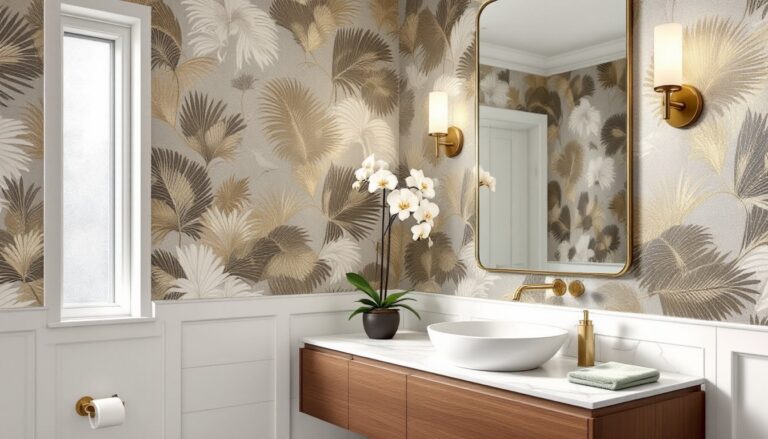
Metallic accents, fixtures, hardware, mirror frames, introduce warmth. Brushed brass or champagne bronze pairs well with white marble and gray tile. Matte black works in modern or industrial schemes but shows water spots: plan to squeegee.
Consider natural materials for warmth: a wood-look porcelain tile (6×48-inch plank format) on the floor, or a teak shower bench. Real wood requires sealing and ventilation but adds an organic note absent in all-tile baths. Browse interior design ideas to see how mixed materials create layered, inviting spaces without sacrificing durability.